
The way you ask for customer feedback—whether it's a survey, an interview, or a simple rating—is what we call the customer feedback format. Picking the right one is crucial. The best formats make giving feedback feel less like a chore and more like a conversation, which naturally leads to more responses and better, more honest insights for your business.
Why Your Current Feedback Strategy Is Falling Flat
Staring at depressingly low survey engagement rates? You're definitely not alone. A lot of businesses are in the same boat, struggling to get the insights they need because they're stuck using old-school methods. The root of the problem is a very real thing called survey fatigue—customers are just plain tired of being asked for their opinion with nothing in it for them.
Think about the difference between getting a long, generic questionnaire in the mail versus having a real chat with someone who's genuinely listening. The first feels like a task to be checked off, but the second makes you feel like your opinion actually matters. That difference is everything.
The Problem with Old-School Methods
When a customer opens a link and sees a static form with a dozen questions, their first instinct is often to just close the tab. It feels transactional and demanding, which is why abandonment rates are so high and the data you get is often incomplete. This isn't just a small hiccup; it's a massive blind spot for your business. Every single person who gives up on your survey is a lost opportunity to understand what they really think.
The numbers paint a pretty grim picture. Traditional surveys are becoming less and less effective, with response rates dropping to an average of just 24.8% for email surveys and a dismal 8-12% for telephone surveys. Even worse, since 2021, only three out of ten customers who stop doing business with a company even bother to explain why. That means companies are left guessing about what went wrong with 70% of their lost customers. You can dig into more of these stats over at InMoment.com.
Sticking with outdated feedback formats means you're actively choosing to miss out on the most valuable customer insights. Poor collection methods hide the early warning signs of churn and get in the way of making real improvements.
A Clear Business Case for Change
The fallout from a broken feedback strategy is huge. Without a steady flow of quality input, you're basically flying blind. You could be sinking resources into product features nobody asked for or ignoring service hiccups that are quietly pushing your customers away.
To really get what your audience wants, you have to rethink the entire process. It’s time to ditch the formats that create friction and start using methods that feel easy and conversational. You can learn more about how to collect customer feedback the right way in our detailed guide. Making this shift is the key to turning data collection from a constant headache into a powerful strategic advantage.
Choosing Your Ideal Customer Feedback Format
Think of your customer feedback strategy like a mechanic's toolbox. You wouldn't use a wrench to hammer a nail, right? The same logic applies here. Relying on just one way to get feedback is like trying to build a house with only a hammer—you'll make some progress, but you’ll miss the crucial details needed to get the job done right.
The secret is matching the right customer feedback format to the specific insight you're chasing. Some methods are built to give you hard numbers, painting a clear, quantitative picture of what customers are feeling. Others are designed to capture the story behind those numbers, giving you the rich, qualitative context that data alone can never provide. Knowing what each tool is for is the first step to building a system that actually gives you answers.
Before you even pick a format, it’s worth thinking about engagement. If you’re not getting many responses, you might have a bigger problem on your hands. This decision tree can help you figure out what's going wrong.
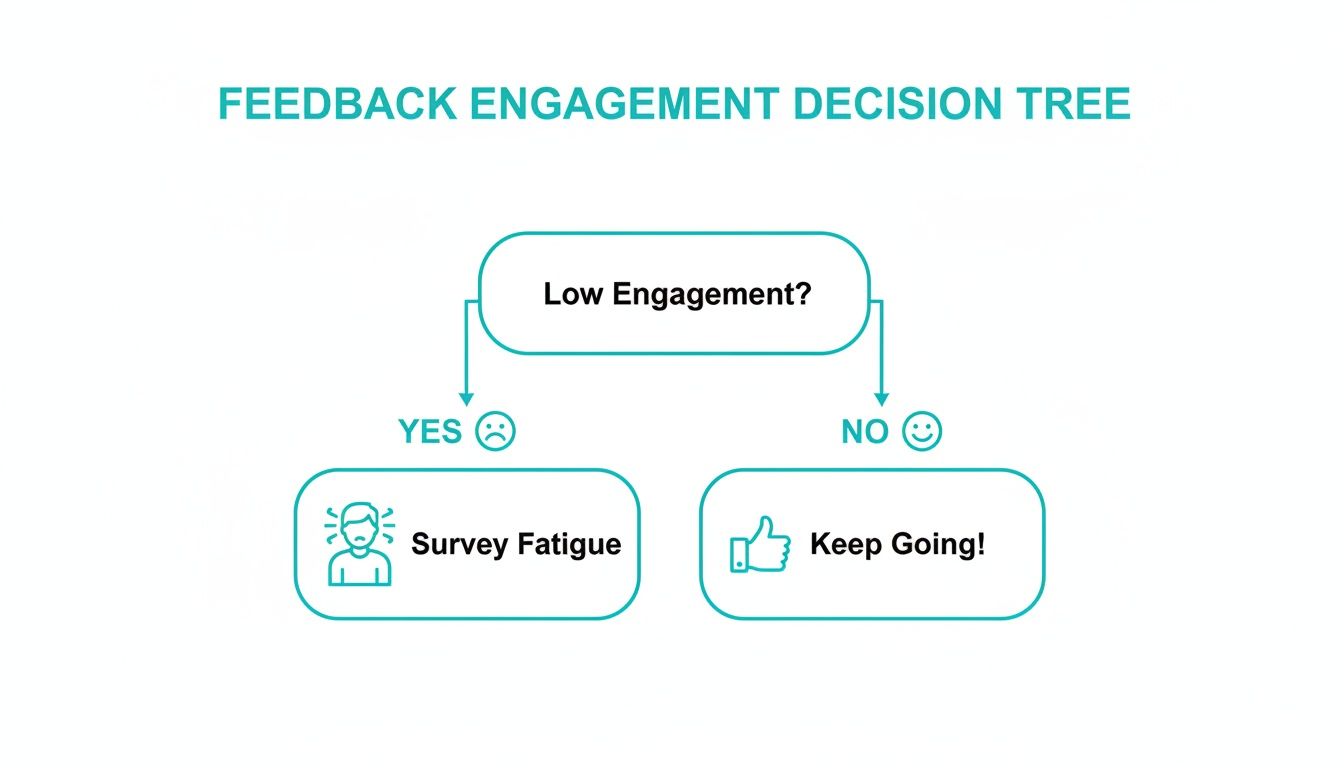
As you can see, low engagement often leads straight back to survey fatigue. It's a classic sign that the format you're using might be the very thing pushing people away.
Understanding Key Feedback Metrics
The most popular quantitative formats are centered around a few core metrics. Each one is designed to ask a very specific question and measure a different piece of the customer experience.
Net Promoter Score (NPS): This is all about gauging long-term customer loyalty. It boils down to one simple question: "How likely are you to recommend our company to a friend or colleague?" on a 0-10 scale. Think of NPS as your pulse check for overall brand health and a predictor of future growth.
Customer Satisfaction (CSAT): CSAT is your go-to for measuring in-the-moment happiness. It usually asks something like, "How satisfied were you with your recent [interaction/purchase/support ticket]?" This gives you immediate, actionable feedback on specific touchpoints, so you can quickly spot problems and fix them.
Customer Effort Score (CES): This one measures how easy you are to do business with. A typical CES question is, "How much effort did you personally have to put forth to handle your request?" A low-effort experience is a powerful driver of customer loyalty.
These metrics give you a fantastic snapshot, but they don't tell the whole story. To truly understand your customers, you need to hear from them in their own words. That’s where qualitative feedback—like open-ended questions and interviews—comes in to reveal the "why" behind the scores.
The most powerful feedback strategies combine quantitative metrics with qualitative insights. A high NPS score is great, but knowing why your promoters love you is what allows you to replicate that success.
A Quick Guide to Common Feedback Formats
To help you decide which tool to pull out of the toolbox, here’s a quick comparison of the most popular formats to see which one best fits your goal.
| Format Type | Primary Goal | Best Used For | Example Question |
|---|---|---|---|
| NPS | Measure customer loyalty | Assessing overall brand health and predicting growth. | "On a scale of 0-10, how likely are you to recommend us?" |
| CSAT | Gauge immediate satisfaction | Getting feedback on specific transactions, like a purchase or support ticket. | "How satisfied were you with your recent support experience?" |
| CES | Assess ease of experience | Understanding friction points in the customer journey. | "How easy was it to resolve your issue today?" |
| Open-Ended | Gather detailed context | Uncovering the "why" behind quantitative scores and discovering unknown issues. | "What is the primary reason for your score?" |
Each format has its place. Your job is to know when to ask for a number and when to ask for a story.
The Power of Conversational Feedback

Think about the last time you faced a long, static online form. Did it feel like a chore? An interrogation, even? Now, imagine that same process felt more like a friendly chat. That's the simple but powerful idea behind conversational feedback.
This isn't just a gimmick; it's a fundamental shift in how we should gather insights. By turning a form into a conversation, you're meeting customers on their own terms. It mirrors the way we all communicate every day on messaging apps, making the entire experience feel more natural and less demanding.
The data backs this up. The move toward digital, chat-based interaction is undeniable. According to Zendesk, 52% of people say they're more likely to stick with a brand that offers live chat. People expect to be able to talk to you, not just fill out your paperwork.
Why Conversational Formats Actually Work
Let's be honest, staring at a long list of questions is overwhelming. It’s a huge mental load, and most people will just click away. A conversational format solves this by presenting one simple question at a time, guiding the user through the process step-by-step.
This approach feels less intimidating, especially on a phone where screen space is precious. It taps into the simple psychology of a back-and-forth conversation, keeping users engaged and curious about the next question. The benefits are pretty clear:
- Better Completion Rates: Breaking a survey into small, manageable chunks makes it feel effortless. That means more people actually finish it.
- A True Mobile-First Experience: Chat interfaces are built for phones. They just work, providing a smooth and familiar experience for your users on the go.
- Higher-Quality Answers: A friendly, conversational tone makes people feel more comfortable. They're more likely to give you thoughtful, honest feedback instead of just one-word answers.
Formbot: Your Conversational Advantage
This is exactly where a tool like Formbot comes in. It’s built from the ground up to be conversational. Instead of presenting a static form, it uses a chat-like interface to collect information. It turns the dreaded task of form-filling into a quick, easy chat.
If you want to dive deeper into the principles behind this, our guide on what is conversational design is a great place to start.
The core idea is simple: when you make giving feedback as easy as texting a friend, you get more of it—and it's better quality.
A conversational format isn't just a design choice. It’s a strategic move to show customers you value their time and want to hear what they really think.
Of course, this approach is perfect for gathering quantitative data, but don't forget the power of qualitative insights. To get the full picture, you can learn more about conducting effective user interviews to add that crucial human element to your findings.
How to Design a Feedback Experience People Actually Enjoy
Let's be honest: nobody wakes up excited to fill out a feedback form. The secret to getting great feedback isn't some magic formula; it's about respecting your customer’s time and making the whole process as painless as possible.
The goal is to design an experience so smooth that users don't even have to think about it. We want to turn a potential chore into a quick, effortless interaction.
This all starts with keeping it brief. If a survey feels like it's dragging on, people will bail. Stick to no more than 10 questions, and aim for a completion time of under five minutes. Every single question you add is another reason for someone to close the tab. Focus only on what you absolutely need to know.
Writing Questions That Get Clear Answers
The quality of your feedback is directly tied to the quality of your questions. You have to be direct, neutral, and incredibly clear. Cut out the industry jargon and, most importantly, avoid leading questions that subtly push people toward the answer you want to hear.
Here’s a quick look at what works and what doesn't:
| Do This (Clear & Neutral) | Not That (Biased & Confusing) |
|---|---|
| "How satisfied are you with our product quality?" | "Don't you agree that our recent product improvements are fantastic?" |
| "How likely are you to recommend us to a friend?" | "Given our excellent service, how probable is it that you would recommend us?" |
| "What is the primary reason for your score?" | "Tell us every single thing you liked and disliked about your comprehensive end-to-end experience." |
See the difference? The examples on the right are either loaded with bias or just plain exhausting to read. They create confusion and can seriously skew your data. Simple and direct always wins.
Making Feedback Effortless with Conversational Design
This is where modern tools can completely change the game. A platform like Formbot is built from the ground up on these principles. Its one-question-at-a-time flow is a perfect example of reducing what experts call "cognitive load." Instead of overwhelming someone with a long list of fields, it feels more like a casual conversation.
The core principle is simple: make giving feedback as easy as texting. When you remove friction, you don't just get more responses—you get better, more thoughtful ones.
Tools like Formbot can generate an entire feedback survey from a simple prompt. Just tell it, "Create a survey to measure customer satisfaction after a support ticket," and it will produce clear, neutral questions in a format designed to convert. Plus, it guarantees a flawless mobile experience, ensuring your customer feedback format works perfectly no matter what device your audience is using.
Turning Raw Feedback into Actionable Insights with AI

Collecting customer feedback is just the first step. The real magic happens when you turn thousands of individual comments, ratings, and suggestions into a clear, strategic roadmap. This is where Artificial Intelligence stops being a buzzword and becomes a business necessity, acting as a powerful engine to make sense of all that raw data.
AI analysis helps you get past just knowing what customers are saying and dig into the far more important why behind their feelings. It essentially transforms a mountain of messy, unstructured text into organized, actionable intelligence that can guide your every move.
This isn't just a niche trend. According to Zendesk, a staggering 70% of CX leaders are planning to weave generative AI into their customer touchpoints in the next two years. That's happening right as 80% of companies are ramping up their CX investments. The message is clear: the future of customer experience is intelligent.
Decoding Customer Sentiments with AI
At the heart of AI-driven analysis is sentiment analysis. Think of it as a super-smart reader that can instantly scan open-ended comments and gauge the emotion behind the words—positive, negative, or neutral. This lets you quantify feelings at scale and track how customer moods shift over time, especially after a big product update or policy change.
Another game-changing capability is thematic coding. Imagine manually reading and tagging thousands of responses by topic like "pricing," "shipping," or "bug report." That could take a team weeks. AI, on the other hand, can do it in minutes, automatically grouping related feedback into neat, understandable categories.
This automated process helps you:
- Identify Emerging Trends: Instantly see if a new issue is starting to bubble up among your users before it becomes a full-blown problem.
- Prioritize Your Roadmap: Use hard data to decide which feature requests are genuinely the most urgent.
- Pinpoint Service Gaps: Uncover recurring friction points in your customer support process that need attention.
AI doesn't just analyze data; it uncovers the hidden stories within it. It connects the dots between a dipping NPS score and a sudden spike in comments about a confusing checkout process, giving you a clear path to improvement.
By automating this kind of deep analysis, you free up your team to do what they do best: strategize and take action. For a broader look at this technology's impact, see how AI in marketing is driving B2B growth. And remember, a tool like an AI form builder not only makes collecting the data easier but also sets the stage for this powerful analytical work.
Building a Feedback Strategy That Actually Works in 2026
As we look toward 2026, the old ways of gathering customer feedback are quickly becoming obsolete. It's no longer enough to just collect data. The future is about creating a continuous, back-and-forth conversation where customers feel like they're genuinely being heard. This means ditching the occasional, static survey in favor of a system that’s woven directly into the customer experience.
A great place to start is with a quick, honest audit of what you're doing now. Take a hard look at your current customer feedback format and ask yourself a couple of simple questions: Does this feel like a real conversation? Can a customer easily finish this on their phone? The answers will shine a light on where you can make immediate improvements, often pointing you toward more dynamic, chat-based tools.
It’s All About the Continuous Feedback Loop
The real goal here is to build a system where insights are always flowing in, not just when you decide to run a quarterly campaign. This means asking for feedback at the moments that matter most, making sense of it quickly, and—this is the most important part—doing something about it.
When customers see their suggestions lead to real changes, like a pesky bug getting squashed or a new feature they asked for, they become your biggest fans. They're far more likely to give you feedback again in the future.
The businesses that win in 2026 won’t be the ones that just collect feedback. They'll be the ones that prove they're listening. Closing the loop isn't just a nice-to-have anymore; it's how you build a loyal following and stay ahead of the competition.
This approach turns feedback from a boring metric into a powerful engine for growth. The key is having an integrated platform to manage this loop without driving your team crazy. Tools like Formbot let you build, send, and analyze feedback all from one place, closing the gap between gathering data and taking meaningful action.
By embracing a conversational style powered by smart AI, you can build a loyal customer base that knows their voice truly matters. Ready to create a feedback experience people actually enjoy? See how Formbot can help you get started.
Frequently Asked Questions
Diving into customer feedback often sparks a few questions. Let's tackle some of the most common ones that come up.
What Is The Best Customer Feedback Format For A Small Business?
If you're a small business, your best bet is something that's easy to manage but still packs a punch in terms of engagement. A conversational form is a fantastic place to start. It feels more like a quick chat than a sterile questionnaire, especially on mobile, which is a huge win for getting more people to actually finish it.
A smart approach is to combine one simple number-based question (like NPS) with a single, open-ended follow-up. Think: "How likely are you to recommend us?" followed by, "What's the main reason you gave that score?" This simple combo gives you both a solid metric and the "why" behind it, all without creating a huge project for your team or a chore for your customers.
How Often Should I Ask Customers For Feedback?
There's no single magic number here—it really depends on what you're asking about.
For transactional feedback, like after a customer buys something or closes a support ticket, you should ask right away. The memory is fresh, and the feedback will be specific and valuable.
But for relational feedback, where you're trying to gauge their overall feeling about your brand (NPS is a classic example), asking quarterly or every six months is a good rhythm. This helps you spot trends over time. The golden rule? Don't bombard the same customer with requests. Survey fatigue is real, and it can tune people out for good.
What Are The Best Ways To Increase Survey Response Rates?
Getting more responses boils down to making the experience effortless and, dare I say, enjoyable. Hands down, the best way to do this is with a mobile-friendly, conversational format that feels less like a form and more like a text message exchange.
Keep it short. Seriously. Only ask what you absolutely need to know. A little personalization goes a long way, too—use their name and mention the specific purchase or interaction. And here's the most important part: always close the loop. A simple "Thanks, we got your feedback and here's how we're using it" shows people you're actually listening. That one step makes them far more likely to give you their time again in the future.
Ready to build a feedback experience your customers will actually enjoy? With Formbot, you can create beautiful, conversational forms in seconds and start gathering the insights you need to grow. Explore our plans and start for free today.